GRUDA 2022: Regularise Now or Risk Losing Your Property Forever

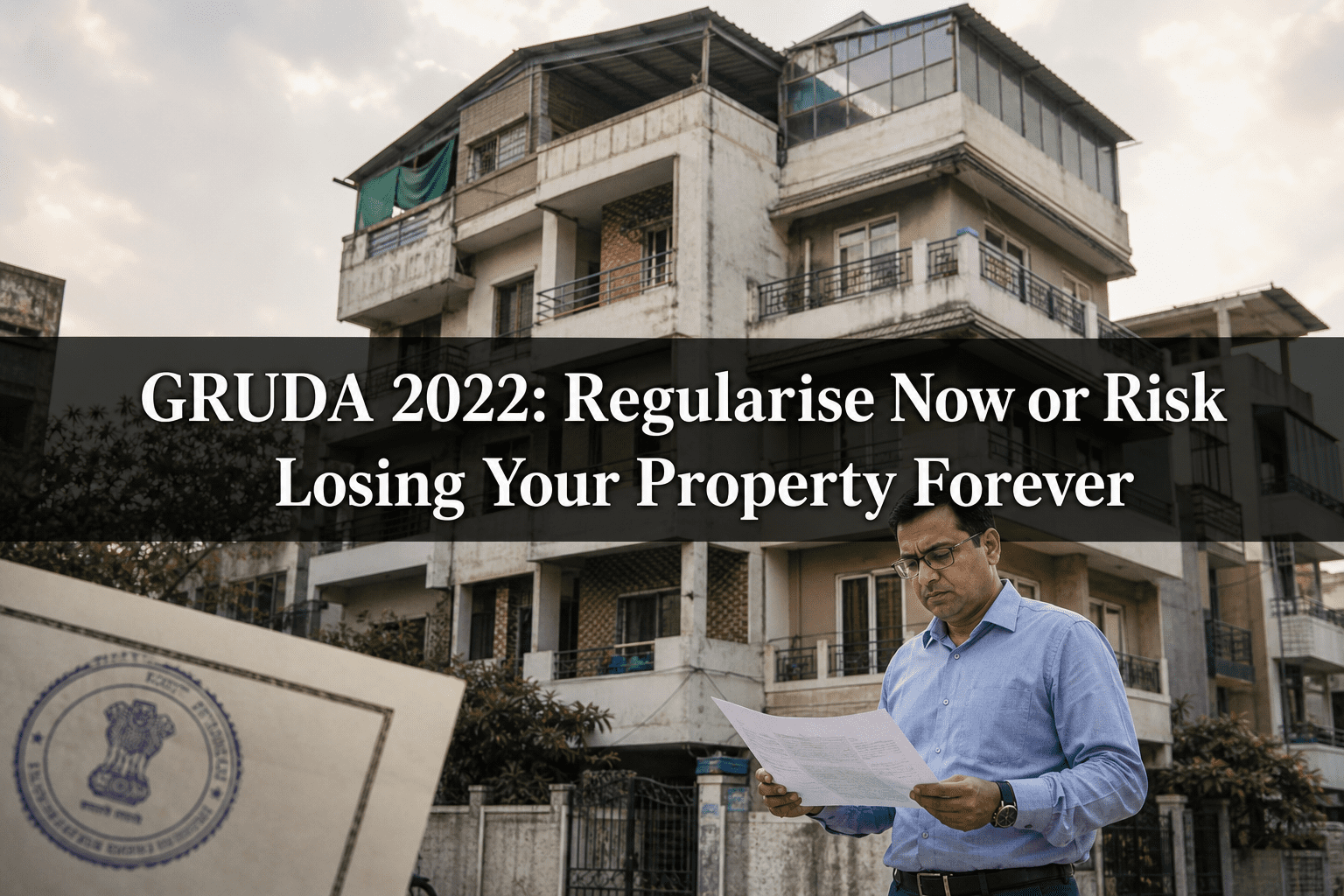
A property owner reviews legal documents outside an unauthorised building in Gujarat under GRUDA 2022 regularisation.

GRUDA 2022: Regularise Now or Risk Losing Your Property Forever

Thousands of property owners across Gujarat are living under the shadow of unauthorised construction — not by intent, but because of inherited properties, expired approvals, or additions made decades ago. GRUDA 2022 exists to fix this. But here is the hard truth: not every property qualifies, the conditions are strict, and the window to act is not permanent. If you have not checked your eligibility yet, you may already be running out of time.

What Is GRUDA 2022 — and Why Does It Exist?

The Gujarat Regularisation of Unauthorised Development Act, 2022 (GRUDA 2022) received gubernatorial assent on 2nd January, 2023, replacing the older 2012 framework. The Urban Development and Urban Housing Department of Gujarat enacted this law with one clear purpose: to bring unauthorised constructions across cities like Ahmedabad, Surat, Vadodara, and Rajkot into a structured legal framework — rather than demolishing them wholesale.

However, GRUDA 2022 is not a blanket amnesty. It is a conditional, time-bound regularisation mechanism. Understanding what it covers — and what it strictly excludes — is the first step every property owner must take.

Who Is Eligible to Apply Under GRUDA 2022?

Owners and Occupiers Both Qualify

Under Section 5 of GRUDA 2022, both the owner and the occupier of a property are eligible to file a regularisation application. This means even long-term tenants may apply — though cooperation with the property owner is practically necessary for documentation.

Who Is Eligible to Apply Under GRUDA 2022?

Applications must be submitted to the Designated Authority for your locality:

  • Municipal Commissioner — for Municipal Corporations
  • Chief Executive Authority — for Urban Development Authorities
  • Chief Officer — for Nagarpalikas

Documents You Must Submit

Every application must be filed in Form A, supported by:

  • Form F — Certificate of Structural Stability from a registered architect or engineer
  • Form G — Certificate of Fire Safety Compliance
  • Form H — Undertaking confirming approvals from other applicable departments

For residential bungalows, tenements, or row houses, the architect/engineer certification requirement is relaxed — but all other conditions still apply.

Properties That GRUDA 2022 Cannot Regularise

This is where most applicants make costly assumptions. The Designated Authority is expressly barred from regularising the following:

  • Properties in zones where permissible FSI is below 1.0
  • Non-residential constructions where FSI consumed exceeds 50% of what is permissible
  • Structures violating road building lines or control lines on classified State roads
  • Constructions violating Right of User under the Petroleum Pipelines Act, 1962
  • Illegal construction on common plots of housing societies — except for community amenities like gymnasiums or libraries, and only with written consent of all co-owners

The last point caused significant confusion in Ahmedabad and Surat following the Act’s enactment. The State Urban Development Department explicitly clarified in November 2022 that individual members who built on shared society plots are excluded from GRUDA 2022 relief.

The Regularisation Process: Step by Step

Step 1 — File Application in Form A

Submit to the Designated Authority within the prescribed deadline, along with all structural and fire safety documentation.

Step 2 — Single Window Processing

The Designated Authority is legally required to maintain a single-window mechanism for submissions, inquiries, and assistance.

Step 3 — Scrutiny Within Six Months

The authority must complete its inquiry and issue a decision within six months of receiving a complete application.

Step 4 — Pay Regularisation Fee (Form B)

If approved, you receive a direction to pay the applicable regularisation fee as notified by the State Government.

Step 5 — Refusal Order (Form D)

If refused, the authority must issue a written order stating specific grounds — which can subsequently be challenged legally.

Is the Application Window Still Open?

The original GRUDA 2022 Ordinance required applications within four months of commencement (October 17, 2022). However, Section 5(2A) of the Act empowers the State Government to extend this deadline by official notification in the Gujarat Gazette — and extensions have been issued.

Whether the window is currently open depends entirely on the latest notifications from the Urban Development and Urban Housing Department. Verify directly with your local Designated Authority before taking any step. Assuming you have time without confirmation is a risk no property owner should take.

What the Courts Are Saying About GRUDA 2022?

Judicial scrutiny of GRUDA 2022 orders is increasing. Legal commentary published in February 2025 highlighted emerging disputes around the enforcement of GRUDA 2022 directives — including challenges to refusal orders and compliance timelines before Gujarat courts.

This matters because a refusal order is not the end of the road. If a Designated Authority has denied your application on procedural or factual grounds, a qualified legal professional may be able to challenge the order before the appropriate Gujarat High Court bench.

Quick Eligibility Checklist Before You Apply

Self-Assessment for Property Owners

Run through this before approaching any authority or legal consultant:

  • ✅ Is your property within a Municipal Corporation, Nagarpalika, or Urban Development Authority jurisdiction in Gujarat?
  • ✅ Does the FSI of your construction comply with zonal norms (permissible FSI of 1.0 or above)?
  • ✅ Is the property on an individual plot — not a common plot of a registered housing society?
  • ✅ Can you obtain structural stability certification from a registered architect or engineer?
  • ✅ Is fire safety certification (Form G) achievable for your structure?
  • ✅ Has your property been registered on the e-Nagar software portal of the State Government?

If every answer above is “yes,” your property is likely eligible for a GRUDA 2022 regularisation review.

Frequently Asked Questions on GRUDA 2022

Can a tenant apply for regularisation, or only the owner?

Both owners and occupiers are eligible under Section 5 of GRUDA 2022. However, full documentation — including structural and ownership details — requires practical cooperation between both parties.

What happens if my application is refused?

The Designated Authority must issue a refusal in Form D with specific grounds. This order is legally contestable before the appropriate forum, including the Gujarat High Court, if procedural or factual errors are involved.

Can a structure violating road setbacks be regularised?

No. Constructions encroaching on building lines or control lines of classified roads are expressly excluded under GRUDA 2022 Rules.

What is the e-Nagar software requirement?

Applicants must register their property details on the e-Nagar portal — the State Government’s digital platform for urban local bodies — as part of the application process.

Does GRUDA 2022 apply only to cities, or to rural Gujarat as well?

The Act extends to the whole State of Gujarat under Section 1(2). However, application processing operates through urban local bodies, so rural applicants should confirm jurisdiction with the relevant authority.

What Should You Do Right Now?

If you own or occupy property in Gujarat with any unauthorised development, the immediate steps are:

  1. Verify the current application window — check the latest notifications from the Urban Development and Urban Housing Department, Government of Gujarat
  2. Run a preliminary eligibility check — assess FSI compliance, plot classification, and structural documentation feasibility
  3. Engage a registered architect or engineer — for Form F and Form G certification requirements
  4. Consult a qualified legal professional — especially if your property falls in a borderline category, or if you have already received a refusal order

GRUDA 2022 is a structured legal opportunity — but it is conditional, time-bound, and unforgiving of inaction.

📌 Disclaimer: This article is published for general informational purposes only and does not constitute legal advice. Laws and their application may vary based on specific facts, local authority notifications, and applicable amendments. Readers are strongly advised to consult a qualified legal professional regarding their individual situation. 

Visit us at: MP Legal Consultants

Blog Authored by : MP Legal Consultants 

0 0 votes
Article Rating
Subscribe
Notify of
guest
0 Comments
Oldest
Newest Most Voted
Inline Feedbacks
View all comments
Name
WhatsApp
0
Would love your thoughts, please comment.x
()
x